
 Image 1 of 1
You’re in the right place if:
You’re planning an event and can’t clearly articulate what it’s supposed to achieve
You’ve been asked about ROI — and didn’t have a real answer
Every planning decision feels like a judgment call instead of a clear yes or no
You’ve delivered events that looked successful but felt hollow
You’re tired of building from instinct when you know strategy should be driving it
If any of those landed — keep reading.
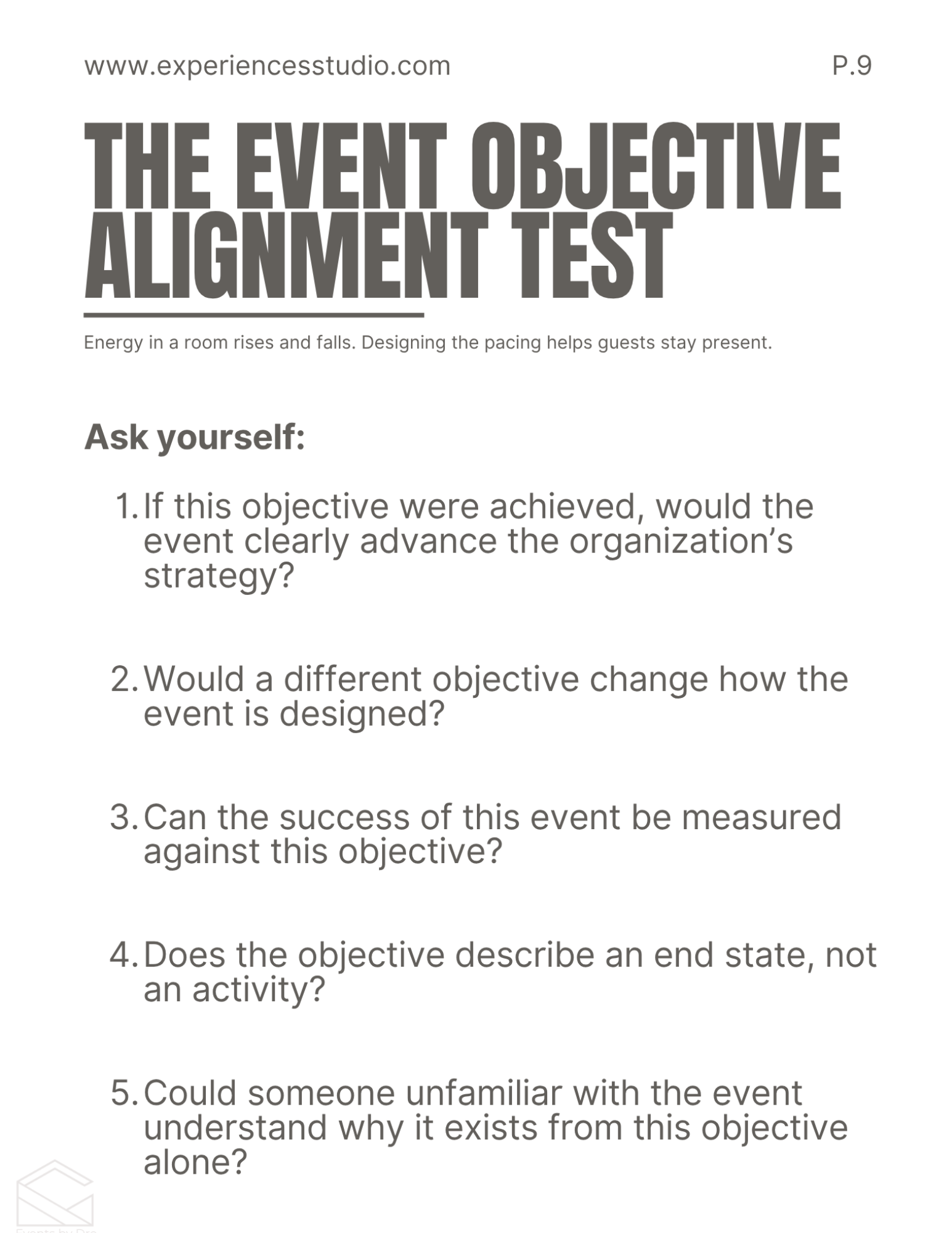

What people are saying:
“I used this before planning our annual leadership summit, and it completely changed how I approached the process. For the first time, I could clearly articulate what the event needed to accomplish — not just what it would look like. It made every decision easier and gave me real confidence going into stakeholder conversations.”
— Sarah, Marketing Director
“As a freelance event planner, I’ve always relied on instinct, but this gave me a way to structure that thinking. I used it with a client kickoff and it helped us move from vague ideas to a clear, aligned objective in one session. It made me look more strategic and made the entire planning process smoother.”
— Daniel, Freelance Event Planner
“This is the step I didn’t realize I was skipping. Everything feels more intentional now.”
— Priya, Community Manager
Why this framework exists
The Event Objective Blueprint was developed from nearly two decades of experience designing high-stakes events — summits, brand experiences, strategic gatherings, and high-profile client events where the margin for ambiguity was zero.
In that work, one pattern showed up constantly: the events that underperformed almost never failed in execution. They failed in definition. The objective was assumed, not designed.
This blueprint codifies the exact process used to eliminate that gap — so that any event, at any scale, starts from a position of strategic clarity.
Built on 19 years of event strategy — applied across corporate teams, brand activations, and high-stakes client environments.
A few things worth knowing:
Is this only for large corporate events? No. The framework is scale-agnostic. It's been applied to intimate client dinners, internal team summits, large-scale conferences, and nonprofit fundraisers. If your event needs to achieve something specific, this applies.
How long does it take to complete? Most people work through the core framework in 30–45 minutes. The prompts are designed to move fast — the goal is clarity, not more time spent in a document.
I already have a goal for my event. Do I still need this? Probably yes — and here's why. Most event "goals" are actually surface-level intentions: "increase engagement," "build brand awareness," "celebrate the team." The blueprint is specifically designed to move you from that level of vagueness to a strategic objective that actually guides decisions. If you can already answer exactly what behavioral or relational change your event is designed to produce, and you have a filter for every planning decision — you might not need it. Most people can't.
What format does it come in? PDF, delivered instantly after purchase. No account required.
Here's the cost of skipping this:
Every planning decision you make from this point either serves a clear objective — or it doesn't.
Without one, you'll keep making calls based on instinct, precedent, or whoever has the strongest opinion in the room. The event will get built. It might even look good. But when someone asks what it achieved, you'll be reaching for an answer that should have been there from the start.
$19 is not the investment to think about here.
The event you're about to plan — the budget, the hours, the stakeholder expectations behind it — that's the investment. This is how you make sure it's building toward something real.
Planning more than one event this year?
The Experience Architecture Starter Pack includes the Event Objective Blueprint, the Guest Experience Mapping Workbook, and the Meeting With Purpose Planner together for $49. That is $23 less than buying them separately, and the three tools work as a connected system — objective first, experience second, execution third.
If you are planning a full event or building a repeatable process, the pack is the better place to start.
→ Get the Experience Architecture Starter Pack — $49
Or continue with the Blueprint only below.
Digital download. Instant access. Use it on your next event, and every event after that.
Not ready yet?
Get the free Event Objective Self-Audit — three questions that will immediately show you whether your current event has a clear strategic foundation.
No purchase needed. Just a starting point.